

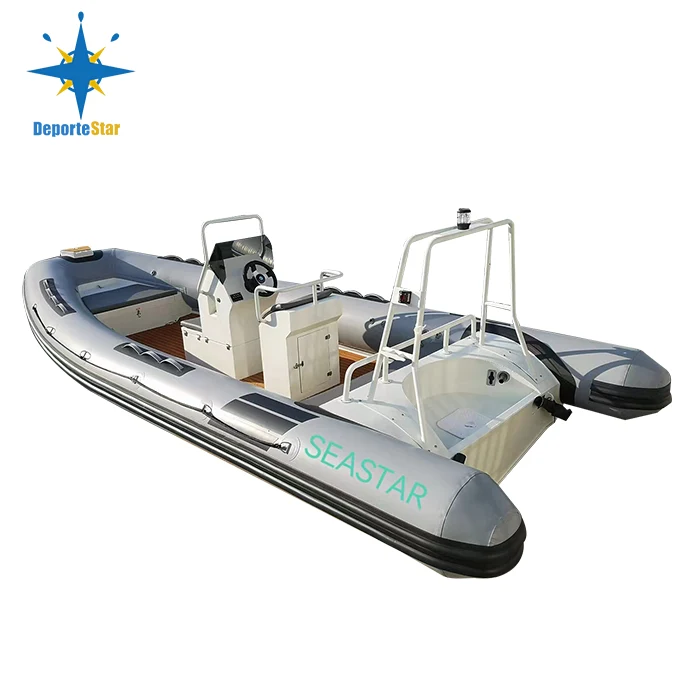
Choosing a hull material is one of the most consequential decisions in rigid inflatable boat specification. This article examines why a Rib Boat Aluminum Hull has become the reference standard for operators who demand structural resilience, predictable weight distribution, and long service life in saltwater, surf zones, and remote shorelines. The discussion moves from metallurgy and welding inspection through hull geometry, corrosion management, and real-world maintenance routines, closing with practical selection criteria and frequently asked questions.
Table of Contents
- Why Aluminum Became the Hull of Choice
- Marine-Grade Metallurgy and Weld Integrity
- Hull Geometry, Deadrise, and Ride Quality
- Weight, Payload, and Propulsion Efficiency
- Aluminum vs. Fiberglass: An Honest Comparison
- Corrosion Management in Saltwater Service
- Maintenance Routines That Extend Hull Life
- Selection Criteria for Professional Buyers
- Frequently Asked Questions
Why Aluminum Became the Hull of Choice for Demanding Operations
A rigid inflatable boat is only as capable as the structure beneath its buoyancy tubes. The inflatable collar provides reserve buoyancy and fendering, but the rigid bottom carries the engine loads, transmits planing forces, and absorbs every impact with water, sand, gravel, or dock structures. When that bottom is fabricated from a properly specified marine aluminum alloy, the vessel gains a combination of properties that composite hulls struggle to match in punishing service.
Aluminum hulls are frequently described in professional literature as rugged and far more able to stand up to wear and tear than composite alternatives. From an operational standpoint, this robustness becomes most visible when a boat is driven onto a beach at speed—a maneuver that could tear the bottom out of a fiberglass hull but is routinely tolerated by a welded aluminum structure . For rescue units, patrol crews, dive teams, and island transfer operators, that tolerance is not a luxury; it is a mission requirement.
The choice of a Rib Boat Aluminum Hull also simplifies long-term structural inspection. Unlike cored composite bottoms, which can conceal moisture ingress behind an intact gelcoat skin, a painted or powder-coated aluminum surface reveals coating damage and early corrosion at the waterline and around fasteners. That transparency allows owners and service yards to intervene before minor cosmetic issues become structural problems.
Marine-Grade Metallurgy and the Discipline of Weld Integrity
Not all aluminum is created equal, and the difference between a serviceable hull and a long-lived one begins at the alloy specification. The dominant material in professional rigid inflatable construction is 5083-H116 aluminum alloy. Its magnesium content—typically in the 4.0–4.9% range—provides inherent resistance to saltwater attack without depending solely on anodizing or coating . The alloy also exhibits a tensile strength of approximately 317 MPa, giving it the capacity to resist repeated impact loads generated during high-speed transit in open water .
Welding Processes That Match the Alloy
Fabrication of a marine aluminum bottom relies on controlled welding rather than mechanical fastening or adhesive bonding. Both tungsten inert gas welding and metal inert gas welding are used, with filler alloys selected to match the parent metal and preserve joint ductility. The 5083 alloy’s low susceptibility to hot cracking supports these processes, with properly executed welds achieving joint strengths approaching 90% of the base metal .
Weld quality is not left to visual inspection alone. Ultrasonic testing is applied to critical cross joints and seam intersections to detect internal defects such as incomplete penetration or slag inclusion—conditions that could initiate fatigue cracking under cyclic planing loads . The combination of appropriate filler metallurgy, qualified welders, and non-destructive examination is what separates a structural hull from a merely watertight one.
Why Weld Consistency Matters More Than Plate Thickness
A common misconception among first-time buyers is that heavier plate alone guarantees durability. In practice, a moderate plate thickness with consistent, full-penetration welds and well-designed longitudinal stiffeners will outperform a thicker plate joined by inconsistent welds. The welded aluminum structure behaves as a system: the plate, the framing, the keel, and the transom must distribute point loads from beaching, trailer support, and engine thrust without creating stress concentrations. Ultrasonic inspection and controlled weld procedures are therefore not production formalities; they are the evidence that the hull’s load path has been executed as designed.
| Construction Element | Specification Focus | Operational Benefit |
|---|---|---|
| Base alloy | 5083-H116 marine-grade plate | Saltwater corrosion resistance and impact strength |
| Welding process | TIG and MIG with matched filler | Joint ductility and resistance to hot cracking |
| Critical joint inspection | Ultrasonic testing at seam crossings | Detection of internal weld defects before service |
| Structural framing | Longitudinal and transverse stiffeners | Load distribution across the bottom and transom |
| Surface protection | Powder coating or high-tensile chromate pretreatment | Barrier protection with visible damage indication |
Hull Geometry, Deadrise, and the Quality of the Ride
An aluminum bottom is not simply a flat sheet bent upward at the bow. The underwater profile determines how the boat transitions from displacement to planing, how it behaves in a following sea, and how much punishment the crew absorbs when crossing steep chop. Two geometric families dominate professional rigid inflatable design: the deep-V hull and the stepped hull.
The Deep-V Alternative
A deep-V bottom with a substantial deadrise angle—often in the region of 23 degrees—is engineered to convert engine power into forward motion while maintaining a confident and predictable ride in real sea conditions . The sharp entry slices through wave faces, while the progressively flattening aft sections generate lift. For operators who regularly encounter short, steep seas, the deep-V form remains the reference for comfort and directional stability.
Stepped Hulls and Drag Reduction
Stepped hull forms introduce one or more transverse breaks in the bottom surface. As air is drawn into the step, aeration reduces wetted surface and friction, allowing higher speeds for a given power input. The approach is not without trade-offs: steps can introduce aeration that interferes with waterjet efficiency, and poorly designed steps may produce unpredictable handling in turns. Designers have responded with variations such as U-shaped “delta steps” that increase aeration from the chine toward mid-keel while preserving clean water flow along the centerline for directional control . The lesson for buyers is that a stepped bottom is a performance tool, not a universal upgrade; it must match the intended speed range and propulsion type.
Beam, Waterline, and Deck Utility
Hull geometry also governs usable space. Increased beam improves stability, deck area, and payload capacity without necessarily increasing the wetted hull footprint while planing, which avoids unnecessary drag . For a rescue or transfer boat, that additional beam translates into safer working space for crew and equipment. The interaction between beam, deadrise, and tube diameter is where naval architecture meets operational practicality—and it is a primary reason why off-the-shelf hull shapes rarely serve specialized missions well.
Weight, Payload, and Propulsion Efficiency
Weight is the silent variable in every performance calculation. A lighter hull reduces the power required to reach a given speed, lowers fuel consumption at cruise, and makes trailering and launching less dependent on heavy equipment. The weight advantage of aluminum is measurable: a well-engineered six-meter aluminum rigid inflatable hull typically weighs 30–40% less than an equivalent glass-reinforced plastic hull . That difference cascades through the entire vessel specification.
A lighter bottom allows the same engine to deliver higher top speed, or the same speed to be achieved with a smaller, less expensive outboard. It also increases the payload margin for fuel, crew, and mission equipment without pushing the boat beyond its designed displacement. For operators who lift boats with davits or launch from unimproved ramps, the weight saving is often the deciding factor between feasible and infeasible deployment.
The weight story is not purely about speed. A lighter hull also reduces the energy that must be absorbed by the trailer, the lifting gear, and the towing vehicle. Over a season of frequent launches, that reduction translates into less wear on ancillary equipment and fewer logistical constraints. The trade-off is that very light aluminum hulls can be more sensitive to load distribution; operators must respect the manufacturer’s center-of-gravity guidance and avoid concentrating heavy gear far from the design load points.
Aluminum vs. Fiberglass: An Honest Comparison Without Hype
Fiberglass remains a legitimate hull material, and the choice between the two is not a simple matter of one being universally superior. A fair comparison acknowledges where each material excels and where each imposes a cost on the operator.
| Consideration | Aluminum Hull | Fiberglass Hull |
|---|---|---|
| Impact response | Dents and deforms locally; generally repairable without major reconstruction | Can crack or puncture; repairs require lamination and gelcoat matching |
| Weight | Typically 30–40% lighter for comparable size | Heavier; can improve steadiness but increases towing and power demands |
| Saltwater durability | Excellent when alloy and coating systems are correct; requires anode discipline | Immune to galvanic corrosion but vulnerable to osmotic blistering and water absorption over time |
| Noise and ride softness | Can transmit more structure-borne noise; deep-V and framing design mitigate this | Generally quieter and softer-riding due to mass and laminate damping |
| Repair specialization | Requires trained marine aluminum welders for structural work | Widely available composite repair skills |
| End-of-life recyclability | Highly recyclable aluminum content | Limited recyclability of cured composite |
Fiberglass hulls tend to offer better seakeeping and stability in some conditions precisely because of their greater mass . That mass can be an advantage for a dedicated fishing platform that benefits from a slower, more predictable drift. However, modern aluminum designs with well-developed deadrise and strategic ballast placement have narrowed that gap considerably. The decision should therefore be driven by the operating profile—beaching frequency, trailering distance, payload priorities, and repair infrastructure—rather than by a blanket material preference.
Another practical distinction concerns noise. Aluminum is an efficient conductor of vibration, and an unsuppressed hull can amplify engine and water-slap noise. Reputable builders address this through structural detailing, engine mounting isolation, and deck treatments. Buyers evaluating a Rib Boat Aluminum Hull should request a sea trial that includes both calm-water cruise and choppy-condition transit, paying attention to structure-borne noise at the helm and in the passenger area.
Corrosion Management in Saltwater Service
The single greatest misconception about aluminum boats is that they are maintenance-free. Aluminum does not rust in the way steel does, but it is electrochemically active, and saltwater is an efficient electrolyte. The protective oxide layer that forms naturally on aluminum can deteriorate in saltwater environments, making the surface susceptible to corrosion if the alloy selection, coating system, and cathodic protection are not managed as a coordinated system .
The Three Corrosion Threats
Galvanic corrosion occurs when dissimilar metals are in electrical contact within an electrolyte such as seawater. Stainless-steel fasteners, bronze through-hulls, and aluminum structure can form a corrosion cell if they are not properly isolated. Stray-current corrosion is a related but distinct threat, caused by electrical faults onboard or in nearby marina infrastructure. The third threat is simple crevice corrosion under trapped moisture, scale, or failed coating, particularly around fittings and at the waterline .
Barrier Coatings and Sacrificial Anodes
A multi-layer defense is the professional standard. Barrier coatings—powder coating, anodizing, or high-quality paint systems—keep the electrolyte away from the bare alloy. Powder coating offers a thick, durable barrier, but any scratch exposes bare aluminum, so the coating must be inspected and touched up . Sacrificial anodes provide cathodic protection by corroding preferentially, and they must be sized and placed according to the hull’s exposure profile. Anodes are commonly fitted to the outboard motor, the engine clamp bracket, and, where appropriate, the trim tabs or hull-mounted hardware .
Hardware isolation is equally important. Fasteners should be installed with isolating washers or sealant to break the electrical path between stainless steel and aluminum. Owners who add aftermarket brackets, electronics, or fittings without considering this relationship can create a localized corrosion cell that will attack the hull around the fastener holes . The principle is straightforward: every new metal-to-metal contact in a saltwater environment deserves a deliberate isolation decision.
Maintenance Routines That Extend Hull Life
A welded aluminum bottom is a long-service structure, but its longevity is not automatic. The maintenance regime is simple and inexpensive compared with structural repair, yet it is frequently neglected because aluminum is perceived as indestructible. A disciplined routine addresses the specific failure modes of the material.
- Rinse the hull, deck, tubes, and fittings with fresh water after every saltwater outing to remove salt deposits before they concentrate in crevices.
- Inspect sacrificial anodes at regular intervals and replace them when they have corroded to roughly half their original mass.
- Check welds, fasteners, and waterline areas for coating scratches, loose hardware, or early signs of pitting.
- Keep drainage paths clear so that standing saltwater does not remain trapped against the aluminum structure.
- Use cleaning products formulated for aluminum and coated surfaces; harsh acidic or alkaline cleaners can damage the barrier layer.
- Touch up coating damage promptly, especially below the waterline and around fittings where corrosion cells are most likely to initiate .
For boats kept on a mooring or in a marina berth, the maintenance burden increases because the hull remains immersed. Periodic haul-out or lifting onto a floating pontoon allows inspection of the bottom and anodes that cannot be performed from the deck. Operators in high-use professional service should treat anode inspection as a scheduled task rather than a seasonal afterthought, because anode depletion is progressive and silent until the hull itself becomes the sacrificial element.
Selection Criteria for Professional Buyers
Specifying a rigid inflatable boat with an aluminum bottom requires more than choosing a length and engine horsepower. The following criteria help structure the evaluation and separate substantive engineering from marketing language.
- Confirm the alloy specification and traceability. Ask for the plate grade, temper, and mill certification. 5083-H116 is the reference material for serious marine service; unspecified “marine aluminum” is not equivalent.
- Review the welding and inspection protocol. TIG and MIG processes should be matched to the alloy, and critical joints should be subject to ultrasonic examination. A builder who cannot describe these procedures is unlikely to control them.
- Evaluate hull geometry against the actual operating profile. A deep-V bottom suits steep chop and offshore transit; a stepped bottom may suit high-speed sprint requirements but demands a sea trial to confirm handling.
- Examine the coating system and anode plan. Powder coating or a documented paint system, combined with correctly sized anodes and isolated hardware, is the baseline for saltwater service.
- Request a loaded sea trial. Weight distribution, engine trim, and hull attitude under real payload are more informative than brochure performance figures.
- Verify after-sales support and documentation. Maintenance schedules, anode locations, coating touch-up guidance, and structural warranty terms should be provided in writing.
A professional manufacturer with in-house design and production control can accommodate customization without compromising structural continuity. For operators seeking a proven platform, Seastar builds rigid inflatable boats with marine-grade aluminum hulls and offers configurations spanning rescue, patrol, tourism, and leisure applications. The company’s production experience and export footprint provide a useful reference point for buyers comparing fabrication standards and delivery capability.
Frequently Asked Questions
Does an aluminum hull corrode in saltwater?
Is a Rib Boat Aluminum Hull heavier than a fiberglass hull?
Can an aluminum RIB be beached on sand or gravel?
How often should sacrificial anodes be replaced?
What is the difference between a deep-V and a stepped aluminum hull?
Does powder coating prevent aluminum corrosion completely?
Ready to specify a rigid inflatable platform with a hull engineered for your operating profile? Contact us to discuss hull geometry, tube configuration, engine matching, and delivery requirements with a team that builds marine aluminum structures for professional service.
Contact Us →