

Abstract
This comprehensive guide explores the engineering, applications, and operational advantages of the 28ft salt water inflatable rib boat, specifically the Aluminum RIB 860 model. From its marine-grade 5083-H116 aluminum hull construction to its ORCA® Hypalon tube technology, every component is designed for the demands of saltwater environments. Readers will gain insights into performance specifications, material comparisons, maintenance protocols, and real-world deployment scenarios across rescue operations, commercial tourism, and offshore fishing.
Table of Contents
- What Is a 28ft Salt Water Inflatable Rib Boat? → Click to jump
- Technical Specifications of Aluminum RIB 860 → Click to jump
- Aluminum Hull vs. Fiberglass: Saltwater Durability → Click to jump
- Hypalon vs. PVC Tube Materials → Click to jump
- Real-World Applications and Deployment → Click to jump
- Engine Configuration and Performance → Click to jump
- Saltwater Maintenance and Care Protocol → Click to jump
- Standard and Optional Equipment → Click to jump
- Frequently Asked Questions → Click to jump
What Is a 28ft Salt Water Inflatable Rib Boat?
A 28ft salt water inflatable rib boat represents the intersection of rigid hull engineering and inflatable tube technology, creating a vessel that delivers exceptional stability, buoyancy, and rough-water capability. Unlike traditional rigid boats, a rigid inflatable boat (RIB) combines a solid aluminum or fiberglass hull with inflatable tubes that act as shock absorbers, fenders, and secondary flotation chambers.
The 28ft salt water inflatable rib boat category is particularly significant because it hits a sweet spot in size: large enough to handle offshore passages, carry substantial payloads, and accommodate up to 20 passengers, yet compact enough to be trailered and launched by a single operator. Marine rescue organizations worldwide, including the U.S. Navy and various coast guards, have relied on RIBs in the 25-30 foot range for decades because of their seaworthiness and mission flexibility.
What sets the 28ft salt water inflatable rib boat apart from smaller RIBs is its capacity to serve as a primary vessel rather than just a tender. With the Aluminum RIB 860, operators gain access to a platform that can be configured for search and rescue, commercial tourism, offshore fishing, or government patrol duties without compromising on any single mission profile.
The design philosophy behind these vessels emphasizes redundancy and safety. Multiple air chambers ensure that even if one tube section is compromised, the boat remains afloat and operable. The deep-V hull design, combined with the buoyancy of the tubes, produces a ride quality that is both dry and stable, even in choppy conditions.
For organizations evaluating fleet options, the 28ft salt water inflatable rib boat presents a compelling case: it requires less dock space than a conventional cabin cruiser, can operate in shallower water, and offers superior impact resilience when coming alongside other vessels or structures.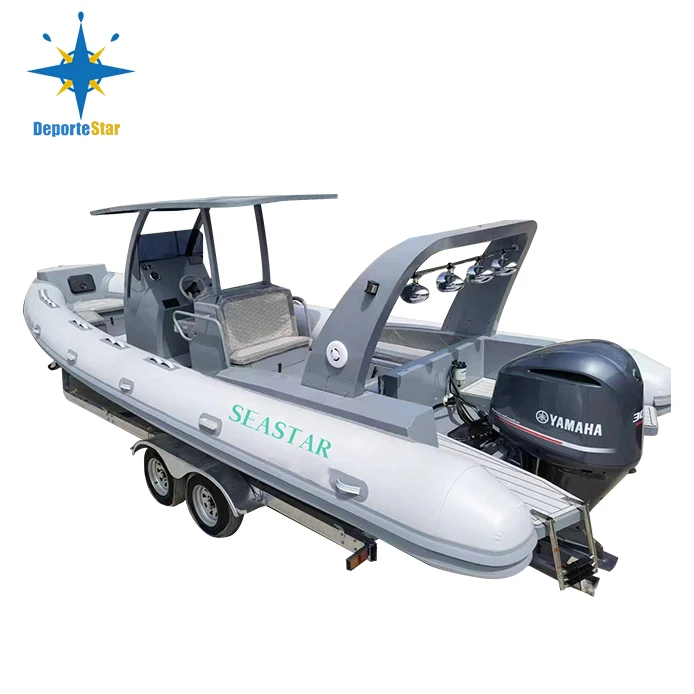
Technical Specifications of Aluminum RIB 860
The Aluminum RIB 860 is a representative model in the 28ft category, manufactured with precision welding techniques and marine-grade materials. Understanding its specifications helps buyers evaluate whether this platform matches their operational requirements.
| Parameter | Specification |
|---|---|
| Overall Length | 860 cm (28.2 ft) |
| Inside Width | 185 cm |
| Tube Diameter | 56 cm |
| Air Chambers | 7 |
| Capacity | 20 persons |
| Aluminum Thickness | 10+5+4 cm (hull composite structure) |
| Recommended Engine | 300 HP, Long Shaft |
| Hull Material | Marine-grade aluminum (5083-H116) |
| Tube Material | ORCA® Hypalon or Valmex® PVC |
These specifications reveal several important design decisions. The 56 cm tube diameter provides substantial buoyancy and acts as a wide, stable platform when boarding from the water or transferring personnel. The 7 air chambers offer redundancy that exceeds many competitor models, which typically feature 5 or 6 chambers in this size range.
Welding and Construction Standards
The Aluminum RIB 860 employs both TIG and MIG welding methods, with ultrasonic inspection performed on cross joints and critical structural seams. The material traceability extends from 5083-H116 aluminum plate through welding wire and shielding gas, ensuring consistent quality throughout the production process.
Beyond the structural welds, the hull undergoes balance testing, flotation verification, and deck water-tightness checks. These quality control steps are particularly important for a vessel of this class that may operate in conditions where structural failure is not an option.
Aluminum Hull vs. Fiberglass: Saltwater Durability
When selecting a 28ft salt water inflatable rib boat, the hull material is arguably the most consequential decision. Both aluminum and fiberglass have merits, but their behavior in saltwater environments differs significantly.
Advantages of Aluminum Hulls
- Aluminum is lighter than fiberglass, improving fuel efficiency and allowing the same engine to achieve higher speeds or greater range. An aluminum RIB of this size typically weighs substantially less than its fiberglass equivalent.
- Aluminum bends under impact rather than shattering, making it more suitable for beach landings, debris-filled waters, and frequent docking.
- Marine-grade aluminum alloys such as 5083, 5086, and 5456 resist corrosion in both fresh and salt water when properly maintained.
- Repair is straightforward with welding, and the hull can be reinforced or modified with relative ease compared to composite materials.
- The entire hull structure can be fabricated in-house, ensuring consistent quality control from material sourcing to final assembly.
Considerations for Saltwater Operations
Aluminum hulls do require attention to corrosion control, particularly around hardware, electrical systems, and areas where dissimilar metals contact the hull. Anodes must be inspected and replaced regularly, and the hull surface benefits from protective coatings or paints. Small scratches that penetrate protective layers can initiate corrosion if left unattended.
However, with a sensible maintenance routine, properly designed marine-grade aluminum hulls are widely used in saltwater environments worldwide. The key is understanding that aluminum does not fail from saltwater exposure alone; it fails from neglect of the protective systems that prevent galvanic and crevice corrosion.
Why Aluminum Excels for the 28ft Salt Water Inflatable Rib Boat
For a vessel that will be trailered frequently, launched from ramps, and used in varying conditions, aluminum offers practical advantages that fiberglass cannot match. The lighter weight translates to easier towing behind standard vehicles, simpler single-handed launching, and reduced fuel consumption during operation.
Hypalon vs. PVC Tube Materials
The inflatable tubes are the defining feature of any RIB, and their material composition directly affects longevity, maintenance requirements, and performance in saltwater.
| Feature | Hypalon (CSM) | PVC |
|---|---|---|
| UV Resistance | Excellent — ages slowly, retains color | Moderate — degrades faster in sunlight |
| Temperature Range | Wide — remains flexible in extreme cold | Narrower — stiffens in low temperatures |
| Abrasion Resistance | High — suitable for intensive use | Moderate — better for light-duty applications |
| Repair Ease | Requires specialized adhesives | Easier to patch with standard kits |
| Weight | Heavier | Lighter |
| Service Life | 10-15+ years with care | 5-10 years typical |
Hypalon, technically known as chlorosulphonated polyethylene (CSM), was originally trademarked by DuPont and remains the benchmark for professional-grade RIB tubes. It offers superior resistance to UV radiation, ozone, chemicals, and extreme temperatures. For a 28ft salt water inflatable rib boat that will be exposed to harsh sun and salt spray, Hypalon tubes represent a long-term reliability choice.
ORCA® Hypalon is a premium variant used in the Aluminum RIB 860, delivering the durability characteristics that rescue and military organizations require. The trade-off is cost and weight; Hypalon tubes are more expensive and heavier than PVC alternatives.
PVC tubes, such as those made from Valmex® material, offer a cost-effective alternative that performs well in moderate conditions. PVC is easier to repair, lighter, and more affordable, making it suitable for recreational users who operate primarily in protected waters or who trailer their boats rather than leaving them moored.
Real-World Applications and Deployment
The versatility of the 28ft salt water inflatable rib boat is best understood through its deployment across diverse operational scenarios.
Search and Rescue Operations
Government agencies and maritime rescue organizations favor RIBs in the 28-foot range because they combine speed with stability and can be launched from shore or from larger vessels. The U.S. Navy's RIB contracts specifically support missions including search and rescue, personnel transport, force protection, and maritime interdiction. The Aluminum RIB 860, with its 20-person capacity and multiple air chambers, is well-suited for mass rescue scenarios where multiple survivors must be recovered quickly.
The self-draining deck, integrated bilge pump, and foam-filled hull sections of the Aluminum RIB 860 contribute to its rescue capability. Even if the boat takes on water, the positive flotation design keeps it operable.
Commercial Tourism and Passenger Transport
Tour operators in coastal regions deploy 28ft salt water inflatable rib boats for whale watching, island hopping, diving excursions, and wildlife tours. The open deck layout provides excellent visibility for passengers, while the tube design allows safe approach to marine life without the noise and wake of a conventional hull. The 450L fuel tank provides extended range for full-day excursions.
Offshore Fishing
Anglers seeking a stable platform for offshore fishing appreciate the RIB's wide beam and self-bailing deck. The 28ft salt water inflatable rib boat can be configured with rod holders, fish finders, GPS systems, and live wells to create a serious fishing machine. The deep-V hull cuts through chop, while the tubes provide a stable casting platform and a safe barrier for children or inexperienced anglers.
Government and Patrol Duties
Law enforcement agencies use RIBs for harbor patrol, interdiction, and surveillance. The inflatable tubes absorb impact when boarding other vessels, protecting both the patrol boat and the target vessel. The Aluminum RIB 860's T-top and roll bar provide mounting points for radar, lights, and communication equipment.
Engine Configuration and Performance
The Aluminum RIB 860 is rated for a 300 HP long-shaft outboard engine. This power rating positions the boat for strong performance across a range of loading conditions.
Single vs. Twin Engine Configurations
- Single 300 HP engine: Lower weight, reduced maintenance, adequate for most recreational and light commercial uses. Top speeds can reach 40-45 knots depending on load and conditions.
- Twin engines (2 × 150 HP or 2 × 200 HP): Redundancy for offshore operations, improved maneuverability when docking, and the ability to limp home on one engine if the other fails. Recommended for commercial, rescue, and offshore fishing applications.
For a 28ft salt water inflatable rib boat operating in remote areas or far offshore, the redundancy of twin engines is not a luxury — it is a safety requirement. Most commercial operators and government agencies specify twin-engine configurations for this reason.
Performance Expectations
With a single 300 HP engine and moderate load, the Aluminum RIB 860 can achieve cruising speeds in the 25-35 knot range and top speeds approaching 45 knots. Fuel consumption at cruising speed is typically 10-20% lower than comparable fiberglass hulls of the same length, thanks to the lighter aluminum construction.
The stepped hull design found on some 28ft RIBs further improves efficiency by reducing friction at speed. This design element allows the boat to get on plane quickly and maintain efficient cruising even when fully loaded.
Saltwater Maintenance and Care Protocol
Proper maintenance is the single most important factor in extending the service life of a 28ft salt water inflatable rib boat. Saltwater is inherently corrosive to metals and can degrade tube materials if left unchecked.
Routine Post-Use Care
- Freshwater rinse: After every saltwater outing, rinse the hull, tubes, engine, and all hardware with fresh water. Pay special attention to screw heads, bolt threads, and crevices where salt deposits accumulate.
- Tube cleaning: Use a mild soap solution and soft brush to remove salt crystals and marine growth from Hypalon or PVC surfaces. Avoid petroleum-based cleaners that can damage tube materials.
- Anode inspection: Check aluminum anodes for excessive wear. In saltwater, anodes typically need replacement every 6-12 months, depending on usage frequency.
- Engine flush: Run fresh water through the outboard cooling system after each use to prevent salt buildup in water passages.
Periodic Maintenance Schedule
| Interval | Maintenance Task |
|---|---|
| After each use | Freshwater rinse, engine flush, visual inspection |
| Monthly | Anode check, hardware torque check, tube pressure verification |
| Every 3 months | Hull coating inspection, electrical connection check, fuel system inspection |
| Annually | Full hull inspection, anti-fouling application, steering system service, trailer bearing check |
| Every 2 years | Tube pressure testing, seam inspection, structural weld inspection |
Protecting the Aluminum Hull
Aluminum hulls benefit from a protective coating system that includes an epoxy primer and a compatible topcoat or anti-fouling paint. Any scratch that exposes bare aluminum should be treated promptly with a zinc-chromate primer or equivalent to prevent corrosion initiation. For boats moored in saltwater, a quality anti-fouling paint prevents marine growth that can increase drag and fuel consumption.
Cathodic protection through sacrificial anodes is essential. Aluminum anodes are the modern standard for salt and brackish water, outperforming traditional zinc anodes in most applications. These anodes should be mounted on the hull, outboard engine, and any underwater hardware.
Standard and Optional Equipment
The Aluminum RIB 860 comes equipped with a comprehensive standard package, with optional additions available for specialized missions.
Standard Equipment
- Bow anchor roller and bow anchor bar
- Console with driver seat
- EVA non-skid chap floor
- 450L integrated fuel tank
- Automatic bilge pump
- Aluminum roll bar with navigation lights
- Aluminum T-top
- Pump and repair kit
Optional Accessories
- Hydraulic or mechanical steering systems
- Sound system with marine speakers
- GPS and fish finder combination units
- Boat cover for storage and transport
- Lockable bow locker for secure storage
- Stainless steel boarding ladder
- Aluminum or stainless steel sunshade
- Galvanized or aluminum trailer with or without brakes
- Luxury cushions and sunbed configuration
- Life jackets and safety equipment
- Electric pump with battery for rapid inflation
- Anchor chain and anchor tray
- Lifting points and towing eyes for crane operations
These options allow the 28ft salt water inflatable rib boat to be tailored to specific operational profiles. A rescue configuration might prioritize lighting, communication equipment, and rapid boarding systems, while a fishing setup would focus on rod storage, fish finders, and live wells.
Frequently Asked Questions
What makes a 28ft salt water inflatable rib boat different from a traditional boat?
A 28ft salt water inflatable rib boat combines a rigid aluminum or fiberglass hull with inflatable tubes around the perimeter. This design provides superior stability, impact absorption, and buoyancy compared to traditional rigid hulls. The tubes act as shock absorbers in rough water, fenders when docking, and secondary flotation chambers for safety. The result is a vessel that is more forgiving to operate, safer in emergencies, and capable of handling conditions that would overwhelm a conventional boat of similar size.
How many people can a 28ft salt water inflatable rib boat carry safely?
The Aluminum RIB 860 is rated for up to 20 persons. However, the practical passenger capacity depends on the mission profile, sea conditions, and the amount of gear being carried. For offshore operations, a more conservative loading of 12-15 passengers plus crew is recommended to maintain performance and comfort. Commercial operators should always consult local regulations and the vessel's CE certification for their specific operating area.
What engine size is recommended for a 28ft salt water inflatable rib boat?
The Aluminum RIB 860 is designed for a 300 HP long-shaft outboard engine. For recreational use in protected waters, a single 300 HP engine provides ample power. For offshore, commercial, or rescue operations, twin engines are strongly recommended for redundancy. Twin 150 HP or twin 200 HP configurations provide similar total power with the safety of a backup engine if one fails.
How often should I replace the anodes on an aluminum RIB in saltwater?
In active saltwater use, aluminum anodes typically require replacement every 6-12 months. The replacement interval depends on water temperature, salinity, and how frequently the boat is used. Inspect anodes monthly and replace them when they have deteriorated to approximately 50% of their original size. Never paint over anodes, as this renders them ineffective.
Can a 28ft salt water inflatable rib boat be used for overnight trips?
While the Aluminum RIB 860 is primarily an open-deck vessel, it can be configured for overnight use with the addition of a sunbed or camping cover. However, it lacks the enclosed cabin and berths of a dedicated cruiser. For extended offshore trips, many operators use the RIB as a tender to a larger mother vessel or arrange shore-based accommodation. The 450L fuel tank provides substantial range for day trips and light overnight excursions to nearby destinations.
What is the difference between Hypalon and PVC tubes for saltwater use?
Hypalon (CSM) tubes offer superior UV resistance, temperature tolerance, and abrasion resistance compared to PVC. They age more slowly, retain their color longer, and are the preferred choice for intensive or professional use in saltwater environments. PVC tubes are lighter, less expensive, and easier to repair, making them suitable for recreational users in moderate conditions. For a 28ft salt water inflatable rib boat that will see frequent saltwater exposure, Hypalon represents the more durable long-term option.
Ready to Configure Your Aluminum RIB 860?
Connect with DeporteStar® to discuss your operational requirements, from tube material selection to engine configuration and accessory packages. Our team will help you specify a vessel that matches your mission exactly.
Contact Us